One Name, Three HOAs: What "Benders Landing" Actually Means for Buyers
September 3, 2026
September 3, 2026
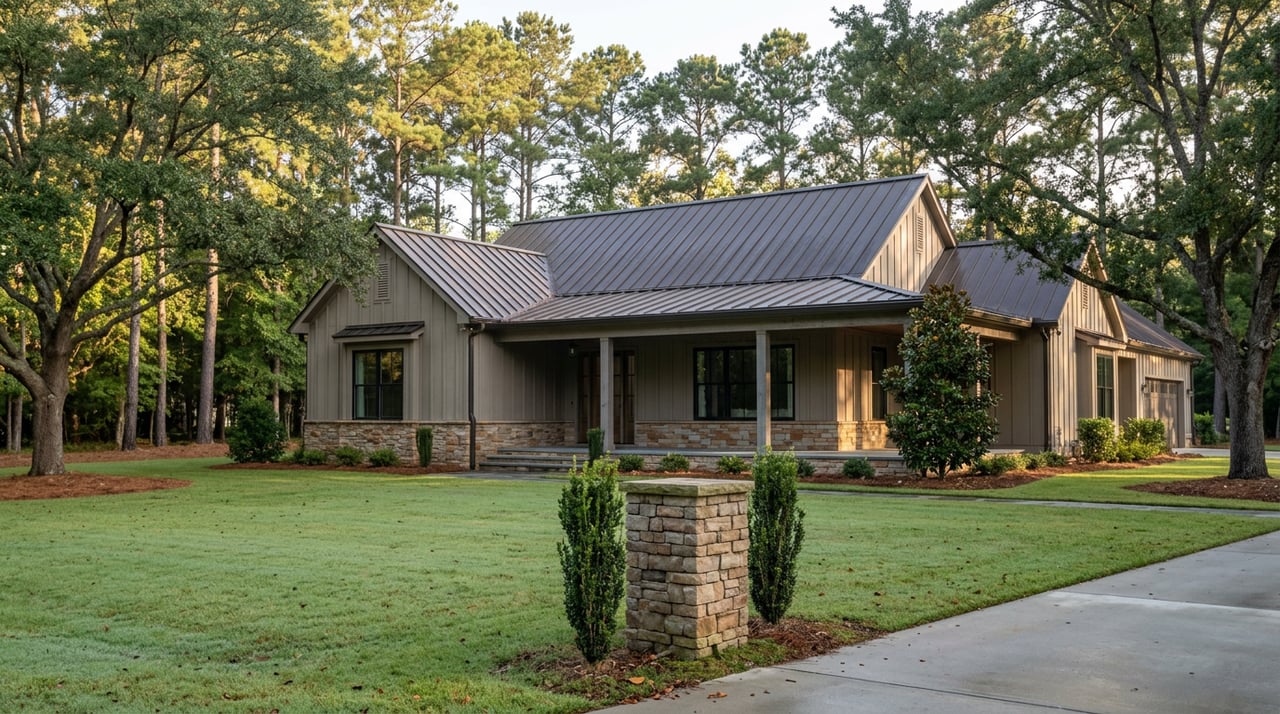
Two houses sit half a mile apart off Rayford Road, both listed under the same neighborhood name, both photographed with the same lake in the background. One belongs to the original Benders Landing community, platted around a 1.1-mile lighted pathway and a stocked fishing lake. The other sits inside Benders Landing Estates, where the clubhouse comes with a resort-style pool, a splash pad, and a banquet hall. A buyer comparing the two on a listing portal would have no way to know that they answer to different homeowners associations, follow different architectural review rules, and pay dues into completely separate budgets.
That is the detail most searches on this neighborhood miss. Portal listings treat "Benders Landing" as a single pin on a map. The public record treats it as at least three separately registered homeowners associations spread across roughly 4,000 acres and a dozen numbered sections. For a buyer who has already narrowed a search to this part of South Montgomery County, the section number on a specific lot matters more than the marketing name attached to the listing.
The developer's own community site is direct about the structure: the full Benders Landing footprint spans more than 4,000 acres, organized into three communities and three separate homeowners associations across over 12 sections and roughly 2,200 homesites. In practice that breaks down into Benders Landing (the original acreage community, home to more than 700 sites), Benders Landing Estates (the larger, amenity-heavy build-out whose state-filed management certificate lists Sections 1 through 7), and Crossroads at Benders Landing Estates, which is filed as its own homeowners association with the state, separate from the Estates POA.
Then there is Castle Court, a gated enclave inside Benders Landing Estates rather than its own HOA, but distinct enough in practice that it functions like a fourth identity within the same neighborhood name.
Socially, none of this shows up. The community's Easter egg hunt has been open to residents of Benders Landing, Benders Landing Estates, Crossroads, and Castle Court alike, one event for four names. Legally, it is a different picture. Each HOA maintains its own deed restrictions, its own architectural control committee, and its own fee schedule. A buyer who assumes the rules governing one section apply neighborhood-wide is working from an assumption the paperwork will not support.
Here is how the pieces line up based on what each community's own materials and public filings describe:
| Name | Governing HOA | What sets it apart |
|---|---|---|
| Benders Landing | Benders Landing POA | Original community, over 700 homesites, park-and-trail amenities centered on a lighted lakeside pathway |
| Benders Landing Estates | Benders Landing Estates POA (state filing lists Sections 1-7) | Fuller clubhouse package: fitness center, resort pool, splash pad, sports fields |
| Crossroads at Benders Landing Estates | Separately registered HOA | Filed independently with the state, distinct from the Estates POA despite the shared name |
| Castle Court | Governed under Benders Landing Estates POA | Gated, 1+ acre lots, faster architectural review timeline |
The takeaway is not that any one of these is a better buy. It is that the name on a listing sheet does not tell you which of these four you are actually purchasing into, and the difference shows up in your dues statement and your builder's timeline before it shows up anywhere else.
This same fragmentation shows up in the sales data, and it explains why two searches for what sounds like the same neighborhood can return two different medians.
As of July 2026, one major listing platform put the median home price in Benders Landing at $1,350,000, with an average sale price of $1,354,541 and homes spending a median of 58 days on the market. A separate neighborhood-overview page on that same platform, drawing on a trailing twelve-month window, listed the median for what is nominally the same footprint at $1,300,000. A third page on the same site, filtered to land listings inside Benders Landing, returned a trailing twelve-month median of $1,256,250. None of those three figures is wrong. Each is measuring a different slice of a name that covers more ground than a single median can describe.
That is the same fragmentation showing up in price data that shows up in the HOA filings. Benders Landing Estates carries a median build year of 2014 across its single-family properties, according to public HAR neighborhood data, reflecting the newer, amenity-heavy build-out anchored by the clubhouse and splash pad. The original Benders Landing section built out earlier and centers its identity on the park and the lakeside pathway instead. Blend a newer, clubhouse-adjacent home with an older, park-adjacent one into a single trailing median, and the result describes an average of two different products rather than a comparable for either one.
If you are pricing a listing or evaluating an offer, the neighborhood-wide median is a starting point, not a comparable. The section-specific comps, pulled for the exact HOA and build era in question, are the ones that will hold up in an appraisal.
Castle Court is worth calling out on its own because it shows how far the variation inside "Benders Landing" can run. It is the only gated section across the entire footprint, built around a stone entrance with EZ Tag access and a private sitting park, with a minimum lot size of one acre across a small run of finished homesites. The developer's own materials for the section state a 24-hour turnaround on new construction review, a faster timeline than buyers should expect elsewhere in the broader community, where architectural control committee approvals move at the pace typical of a larger, multi-section HOA.
Community materials for both Benders Landing and Benders Landing Estates also state that no Municipal Utility District tax applies. That is a real financial detail worth knowing, and it is also exactly the kind of claim that needs verification at the parcel level rather than the neighborhood level. Tax bills are assembled by address, not by marketing copy, and the specific section, plat, and improvement district assignments for a given lot are what actually determine what shows up on the statement.
A few questions are worth resolving before a contract goes in, not after:
None of these questions are unusual for an acreage community with this much internal variation. They are just easy to skip when every listing under the name looks like it belongs to one neighborhood.
Is Crossroads at Benders Landing Estates the same as Benders Landing Estates? No. Despite the shared name, Crossroads is filed as its own homeowners association separate from the Benders Landing Estates POA, according to the state HOA management certificate on record.
Do all four sections have access to the same amenities? Not automatically. The clubhouse, resort pool, and splash pad are tied to Benders Landing Estates. The original Benders Landing community centers its amenities on its own lakeside park and pathway. Access should be confirmed for the specific section before assuming which facilities come with a given address.
Does the "no MUD tax" claim apply to every lot? Community materials describe no MUD tax across both Benders Landing and Benders Landing Estates, but tax assignments are parcel-specific. The current tax bill for the exact lot is the only reliable confirmation.
The neighborhood name will keep doing its job of telling you where the woods and the lakes are. It just will not tell you which HOA sent the last dues invoice or how long the architectural review will take on a new build. That level of detail comes from reading the section, not the sign at the entrance.
If you are comparing homes across Benders Landing, Benders Landing Estates, Crossroads, or Castle Court and want the section-specific comps and HOA documents pulled together before you make an offer, reach out to Elaina Franco. Let's Connect.
Stay up to date on the latest real estate trends.

Ready to buy or sell in Texas? Work with Elaina Franco for expert guidance, local insight, and a smooth, stress-free experience from start to finish. Let’s make your next move a confident one.